
What we practice together
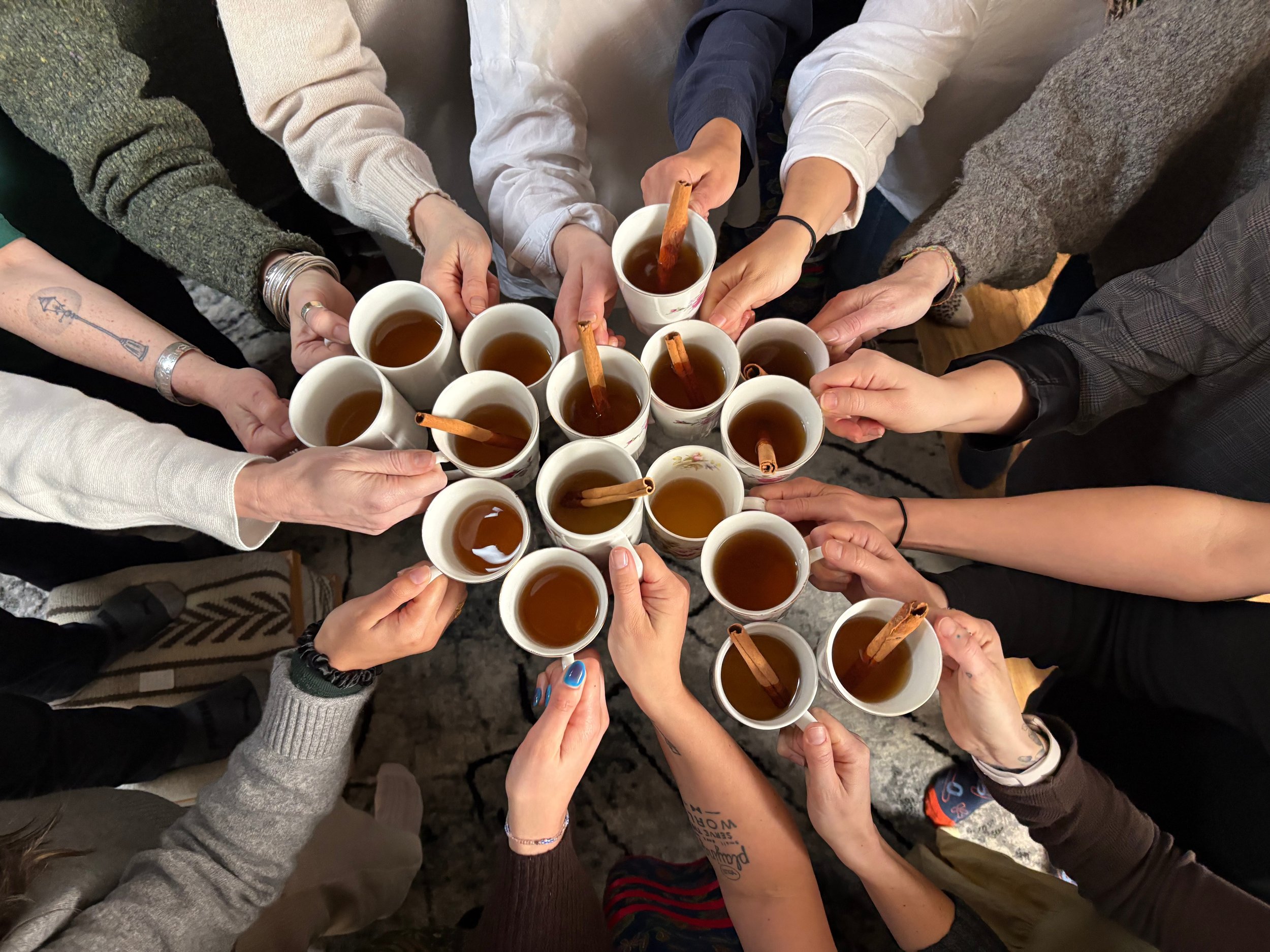
Hands are seen holding tea cups, clinking together to signal that the Birth and Family Stewardship Wise Council was born. Photo by: Paul Lacerte
What we practice together
This piece was written by Erin Beattie as a reflection of the Wise Council for the Southern Vancouver Island Birth and Family Stewardship Centre, working to restore birth as ceremony and to create community-rooted, relational care for families and birth-workers.
—
On Saturday, January 31, we gathered for the first Wise Council visioning day at Jace and Paul Lacerte’s home along the Colquitz River. Many of us arrived carrying a mix of excitement, nerves, and quiet apprehension. From where I stood, that made sense. This work asks a lot of us. It asks us to show up as whole people.
What stood out to me almost immediately was how carefully the day was held.
Care began before arrival. We knew where to park. We knew how to enter. As I walked up the path, there was a sign welcoming us. Inside, coats were hung, shoes were taken off, and people arrived in their own time. Nothing felt rushed. Nothing felt assumed.
The room was arranged in a circle. Each chair had a name on it. We were invited to move and sit wherever we felt most comfortable, but a place had been held for each of us. From my perspective, that small act said a lot. There is space for you here. You belong.
Introductions didn’t happen in the usual way. Instead of resumes or roles, Jace introduced each person through relationship. How we came into her world. What gifts we bring. Why we were called into the circle. I experienced this as being seen through someone else’s eyes, and it mattered.
The opening ceremony grounded the day in lineage and continuity. Land acknowledgement. Drum. Smudge. Calling in mothers, grandmothers, and ancestors. Naming that this is birth work, and that birth is never just about one moment or one person. It is about becoming. Belonging. Legacy.
Throughout the day, ceremony and logistics felt inseparable. Food was shared. Breath work and aromatherapy created space to settle. Tobacco was offered in gratitude. We spoke together about what safety means to us. Being held. Being seen. Being listened to. Not in theory, but in our bodies.
When the conversation turned to imagining the birth house, what I noticed was that we didn’t start with programs or policies. We imagined gardens with medicine. A kitchen where families are fed. Bunk beds for birthworkers’ children. Laundry facilities. Quiet rooms. Tools. Light. Space to rest. A home designed for real lives, not just ideal moments.
The day closed the way it began, in relationship. A gratitude song. A tea ceremony where many small offerings became something shared. A feast prepared and offered with care. I left feeling nourished, grounded, and aware that something important had begun.
What I took away from the day is that we didn’t just talk about the birth centre. We practiced it.
We practiced welcoming before asking.
We practiced holding space before setting direction.
We practiced ceremony without performance.
We practiced leadership as stewardship.
We practiced designing for nervous system safety, not efficiency.
We practiced thinking in generations, not deliverables.
From my vantage point, this day already reflected the birth centre we are imagining. A place where care is infrastructure. Where people are witnessed into becoming. Where home, ceremony, and community are not separate ideas.
It feels important to name this now, while the work is still early. Not to lock anything in, but to remember what we are protecting as this vision takes shape.
I’m grateful to everyone who brought their presence, their stories, and their care into the circle. This work is just beginning, and it is already being held with intention.
What this practice makes possible
Spending time in this circle surfaced something I’m still sitting with.
I expected to be moved. I didn’t expect to feel held.
What stayed with me was how intentional every detail of the day was. Nothing felt accidental. Nothing felt rushed or performative. That level of care made it easier to soften, to arrive without bracing or translating myself. I didn’t have to explain what I needed in order to feel safe enough to be present.
That kind of attunement isn’t generic and isn’t one-size-fits-all. It’s responsive. It’s relational. It’s built through attention, trust, and respect woven into the experience itself.
Being part of this work has made me wonder what becomes possible when care is treated as infrastructure rather than an add-on. When people are met, not managed. When transitions are held with dignity rather than efficiency.
I don’t have tidy answers. But I do know this: when care is practiced with intention, it doesn’t just support people. It reveals them.
And that feels worth protecting as this vision continues to take shape.
_
To learn more about the Birth and Family Stewards Centre and follow the work as it unfolds, visit coya.ca/familystewards. The website is currently in development, with more information to be shared soon.
To follow more of Erin’s thought leadership subscribe to the Engage and Empower Newsletter.
