
Vietnam: A Honeymoon, A Homecoming, A Reminder
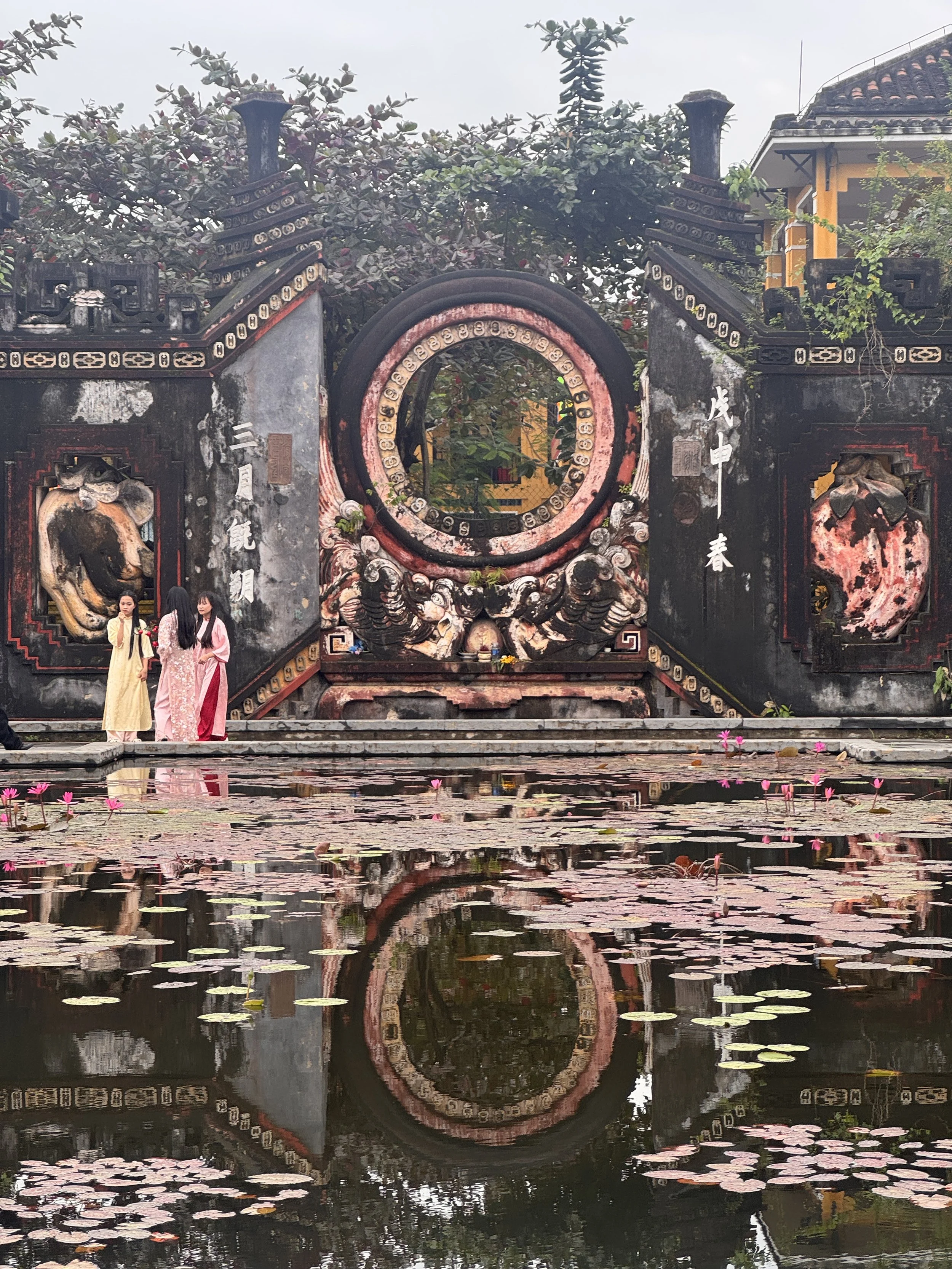
The Ba Mụ Temple Gate (also known as the Cẩm Hà Gate and Hải Bình Gate), Hoi Ai Vietnam Photo By: Jace Poirier Lacerte
Vietnam: A Honeymoon, A Homecoming, A Reminder
My husband and I chose Vietnam for our honeymoon. We were drawn to the ceremony of Tết, the communism of the country, and the deeply ceremonial nature of the people. Rice paddies, misty mountains, expansive markets, bustling nightlife, and quiet beaches offered enough variety to feel like an adventure of a lifetime.
I was called to this place in ways I couldn’t explain.
Following our intuition, we found ourselves standing in a courtyard in Hội An. A reflection pond mirrored a portal in a wall—separating two worlds. A sanctuary tucked within sprawling storefronts quietly called me in. Paul took a photo of me standing in front of it before we even understood where we were.
To my delight, this place was literally a portal between worlds: a monument celebrating twelve midwives who birthed the people of this place, alongside Mazu, the Mother Goddess of the Sea. Without knowing it, I had been drawn directly to one of the most transformational spaces of our journey.
The Ba Mụ Temple Gate (also known as the Cẩm Hà Gate and Hải Bình Gate) is actually two architectural and religious structures located side by side—much like the many belief systems that coexist among Vietnamese people. Legend says it was designed through a dream of a safe and happy life.
That is the dream Paul and I are co-creating together.
As someone who has carried the name The Grand Mother across many lifetimes—as shared with me by Aria Parisian, a well-respected medium—and who has been seen by medicine women as having a portal in my belly where ancestors pass through, finding myself in this moment was awe-inspiring.
How do we arrive at places like this without even knowing they exist?
Is it grand design? Karma? Destiny?
These questions live alongside others I carry, like:
How do I know when babies will arrive?
How do I hear their names before parents speak them aloud?
This sense of connectedness—this shared cosmology—is the exact magic I live for. Vietnam was cooking up wonder as abundantly as its street food.
Coming from Hạ Long Bay in the north, where we visited Cát Bà Island, it became clear to me that Vietnam is a person-first, place-based society in a way that contrasts deeply with life back home in Canada.
Cát Bà means Women’s Island. Its much smaller neighbour—Man Island—is dwarfed in both size and population by its feminine counterpart. Over time, I came to understand Vietnam as a place where family and the feminine are deeply prioritized.
From the earliest moments of pregnancy, women are supported, surrounded, and held. Their status is stewarded by goddesses worshipped by all—including the Lady Buddha. When a society prays to women—not just one man, or men—something shifts. For the better. For everyone.
What struck me even more was the culture surrounding pregnancy and postpartum care. Vietnam feels far ahead of countries like my own, where maternity leave and postpartum recovery are still debated, underfunded, or framed as burdens on productivity.
In contrast, the long-standing practice of Ở cữ—pronounced roughly “uh-koo”—may be one of the quiet keys to the health and longevity of Vietnamese families.
Ở cữ, meaning “moon cycle,” is a protected postpartum period traditionally lasting 100 days. While modern adaptations have softened some practices, the core remains: birthers are shielded from responsibility, public demands, and household labour. At minimum, women receive 30 days of full-time care after birth.
This understanding of care is what led us to The Joyful Nest—a modern postpartum retreat centre in Ho Chi Minh City. Families arrive after birth to receive 24/7 support, nourishing meals, complete baby care supplies, and the shared presence of other newly birthed families. There are pools, tai chi, yoga, and—most importantly—rest. No chores. No expectations. Just recovery and bonding.
Being there made me curious about the care offered to non-birthing parents and the roles men play during this time. While traditional gender roles still exist, men are expected to carry the full household load or ensure support is provided through family or hired help.
What stood out most was the practice of filial piety—the responsibility to care for Elders and teach children to do the same. Like many Indigenous cultures across Turtle Island, Vietnamese families live intergenerationally. Aging parents are rarely isolated or institutionalized. Instead, the eldest son traditionally carries responsibility for their care through to their final rites of passage.
As a birthworker, a Family Steward, and now a newly married woman, Vietnam didn’t just offer me rest—it offered me remembrance.
It reminded me that birth is not an event to recover from alone, but a ceremony that reorganizes families, roles, and responsibilities. It showed me what becomes possible when societies invest in care rather than urgency, in people rather than productivity.
This journey affirmed what I have always known in my body: that how we care for birthers, non-birthing parents, and Elders shapes not only individual families—but entire cultures.
At Family Stewards, we are working to re-member these truths. To steward families into community. To restore postpartum care as essential. To honour birth as a rite of passage worthy of time, tenderness, and collective responsibility.
Vietnam didn’t teach me something new.
It reminded me of what I am here to help bring home.
