
A Landmark Moment for Women’s Health: A Strong Foundation for a Birth Centre
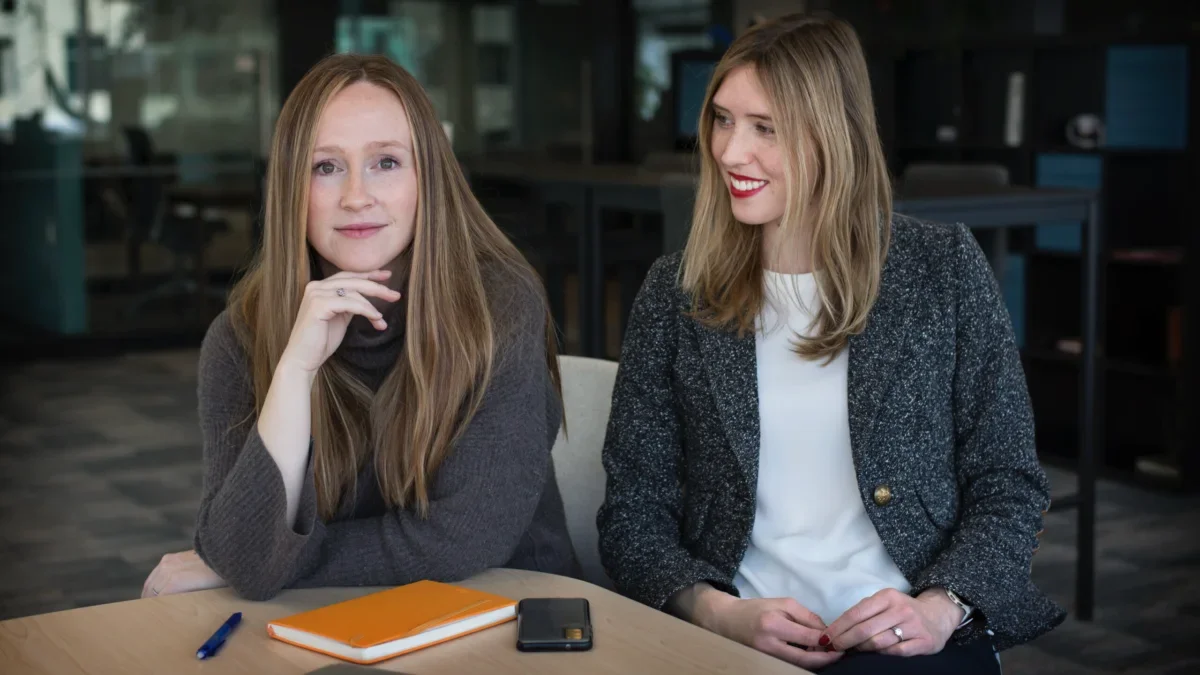
Danika Kelly (left) and Renee Kokts-Porietis co-founded My Normative in 2020 after noticing gaps in female-specific data. Photo by Jennifer Friesen/Digital Journal
Building a Birth Centre on Solid Ground: Witnessing Danika’s Historic Work for Women’s Health
Every once in a while, someone you grew up with turns out to be the kind of woman history books will talk about — the kind of woman who didn’t just notice the gaps in the world, but stepped into them with her whole heart and her whole intellect.
For me, that woman is Danika, my high school classmate, who has been steady and relentless in her mission to correct one of the most astonishing oversights of our time:
women’s bodies were never coded into the design of our medical, scientific, or technological realities.
She didn’t wait for permission to change that.
She built MyNormative, one of the first platforms to collect meaningful, ethical, inclusive data on women’s bodies — data that wasn’t extracted, sold, or distorted, but gathered for us, with the intention of serving us.
In a world where women’s health has been an afterthought for centuries, she dared to ask:
What would medicine look like if it finally included us?
What would diagnostics look like?
What would treatment look like?
What would care look like when built on a foundation of truth instead of assumptions?
And now, she has carried that question all the way into the Senate of Canada.
Thank you Danika for championing Bill S-243 — the National Framework for Women’s Health Act, a piece of legislation bold enough to acknowledge what women have known forever:
We cannot improve women's health if we do not understand women’s bodies.
For most of modern history, our physiology has been treated as a rounding error.
- Crash test dummies were designed around men.
- Medications were dosed for men.
- Menopause research was basically a blank page.
- And, unbelievably, tampons weren’t tested using real blood until 2023.
When you see the gaps laid out like that, it’s hard not to laugh and cry at the same time.
Women have been living inside a healthcare system that was never designed with us in mind — and Danika has been one of the rare people willing to stand up and say, “Enough. It’s time to write us into the code.”
Bill S-243 is that rewriting.
It says:
Study us.
Measure us.
See us.
And finally, build care with us in mind.
For the Birth Centre we are building on Southern Vancouver Island, this matters more than words can express.
Birthwork depends on understanding.
Safety depends on understanding.
Ceremony depends on understanding.
A Birth Centre built in the 2020s cannot rely on the medical understandings of the 1920s. We need research that reflects the bodies who give birth today — bodies shaped by lived experience, culture, trauma, ceremony, hormones, fascia, lymphatic systems, and the deep knowing that has always existed outside the walls of hospitals.
And now, with Bill S-243, it feels like the country is finally catching up.
And So I Couldn’t Help but Wonder… Will It Make It All the Way Home?
Danika has done something extraordinary — something history will remember. She walked into the Senate, held her ground, and said what generations of women have whispered under their breath: study us, understand us, take us seriously.
And she did it with the clarity and courage of someone who knew exactly what was at stake.
But even with all this progress, I find myself in that familiar place women often stand — between celebration and uncertainty. Between pride and a deep, ancestral sigh. We’ve come so far, and yet the path ahead still has a few more hoops, a few doors that need opening before this becomes the law of the land.
And so I couldn’t help but wonder…
Will Bill S-243 make it through the House of Commons?
Will our daughters and granddaughters one day look back and say, “That was the moment everything changed”?
Or will we be telling the same stories, the same frustrations, the same “if only”s decades from now?
Because here’s the thing: women have always done our part. We’ve carried the pain, the pregnancies, the late-night Googlings of symptoms that never quite fit the textbook. We’ve carried the fear that comes from not knowing our own bodies because no one ever bothered to study them. We’ve carried the quiet strength of figuring it out anyway. In red tents, around the cooking pot, and in the whispers of old wives that have passed down live saving knowledge for generations.
And now, in 2025, we stand at the edge of something we have earned ten times over:
a future where women’s health isn’t a guessing game, but a field of research worthy of rigour, funding, and respect.
Danika pushed this door open.
The Senate heard us.
Canada is listening — finally, truly, maybe for the first time.
And I want every woman reading this to feel that spark of recognition:
This matters.
This is about us.
This is about the bodies that carried generations, the wisdom that held nations together, the birth stories that shaped families. This is about finally seeing ourselves reflected in the science, the data, the policies, and the care.
So as we build our Birth Centre — a place rooted in understanding, ceremony, touch, and truth — I find myself asking:
Will Canada choose to walk with us the rest of the way?
Will this Bill become the foundation our daughters can stand on, instead of the gap we had to leap over?
I suppose, like any good birth story, we’re still in the labour of it.
But oh… what a beautiful outcome it could be.
Danika, we see you, and celebrate the consequences of your actions.
Thank you.
